


Savasana as Medicine: How Stillness Supports Healing and Stress Recovery
- Joy Zazzera

- 2 days ago
- 3 min read
If you’ve taken a yoga class before, chances are you are familiar with Savasana as the final relaxation pose that concludes the movement experience. But Savasana is not the end of practice. It is where practice becomes part of you, and it can also serve as a stand-alone experience. So let’s take a deeper look at what it means and explore it's medicinal qualities.
The word “Savasana” comes from SHAVA, meaning “corpse.” It implies becoming quiet to the outside world and alive to the inside. In my perspective, this is critically important. Modern yoga—and modern life—are full of movement and doing. Savasana is the moment where we shift into simply being with the present moment. We’re not doing anything. We’re being still, even moving away from thinking. This is where the fresh integration of your yoga experience happens. In my classes, I direct students to notice therapeutic effectiveness and yoga’s integrative work as the residue felt in the stillness of Savasana.
Savasana as Medicine
Just like eating is not complete without digestion, practice is not complete without integration. What we learn, experience, and challenge in the body must be processed to become part of us. In a Yoga Therapeutics framework, this is essential: anytime we load joints, explore mobility, challenge tissue, or shift breath, the body needs quiet integration. Movement is the meal; Savasana is where it becomes nourishment. Without integration, we’ve only done the work—we haven’t received it.
In a culture that prioritizes productivity and effort, Savasana offers something radically different. It’s the shift from output to assimilation, from managing the world to meeting ourselves. We’re not acting, fixing, or creating. We’re allowing the body and nervous system to settle into receptive awareness.
This is also a profoundly necessary stress-reduction practice. Being alive in a world of nonstop information, critical thinking, emotional processing and managing and overcoming challenges, we need a simple physiological, emotional, and mental downshift. Savasana is one of the most powerful ways to reduce stress. Meditation is another. Often, they can occur simultaneous.
When we practice yoga — Savasana is not a “have to,” rather, it’s a “get to.” It’s a present we give ourselves and, ultimately, our skilled-presence is a present we give the world. By training the skill of presence, our presence in real-time becomes more regulated, grounded, and centered.
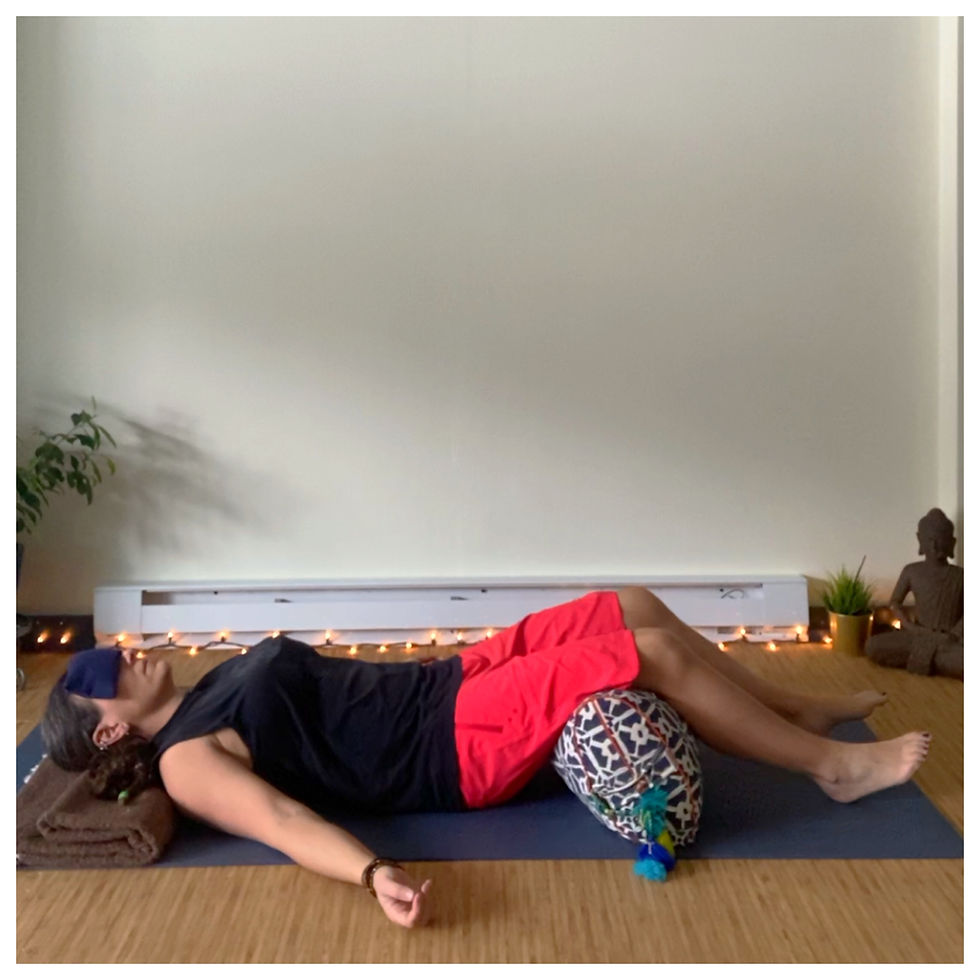
This experience supports our spiritual, mental, and physical health. Savasana — and meditation — are of the rare moments in our day where we can be completely ourselves without expectation or performance. That alone is deeply therapeutic. Savasana, can also serve as a stand-alone practice offering a nourishing refuge from over-stimulation and, as physical recovery from over-training. Practiced independently of a movement experience, Savasana is a radical act of presence. This active relaxation practice engages the parasympathetic nervous system — our rest and digest mode. Time spent training this side of the nervous system sends subtle safety signals to the brain, helps regulate the stress hormones cortisol and adrenaline, lowers blood pressure and supports homeostasis in all of the body’s systems. With the support of props, positionally, the body aligns into a mindfully-arranged reclined and intentionally symmetrical shape, inviting comfort, ease, surrender, safety, warmth and ultimately, stillness.
Even redistributing five minutes of your day to stillness can transform the quality with which you align and engage with your external environment.
Savasana is something we receive: – a gift to the nervous system – a gift to emotional wellbeing – a gift to presence – and a gift to the people around us, whether they notice it or not
As one’s experience with yoga and meditation grows, Savasana becomes the anticipatory time where the therapeutic value is felt and enmeshed in the brain and body— in the quiet “doing nothing,” something profound is happening. Savasana reminds us that stillness is not the absence of life or energy—it’s where life and healing finally have the space to touch us.


Comments