Yin, Yang & the Five Elements
- Joy Zazzera

- Dec 16, 2025
- 5 min read
Updated: Dec 22, 2025
How Understanding Yin and Yang & Traditional Chinese Medicine Can Inform Your Therapeutic Yoga & Meditation Practice
Many women come to yoga and meditation later in life not because they want to perform, sweat, or push harder — but because something feels off.
Energy fluctuates. Sleep changes. Stress lands differently. Old injuries speak louder. Motivation isn’t what it used to be — or it shows up inconsistently.
One of the most helpful frameworks I’ve studied through my Yoga Medicine training comes from Traditional Chinese Medicine (TCM). While it doesn’t translate directly into Western medical language, it offers something incredibly useful:
A way to understand the body as dynamic, responsive, and shaped by seasons, emotions, lifestyle, and lived experience — not just symptoms in isolation.
Yin and Yang: Not Opposites, but a Relationship

In TCM, Yin and Yang are not static categories. They describe a relationship — a continuous process of change.
Yin represents cooling, nourishing, inward, quiet, structural qualities
Yang represents warming, activating, outward, functional, moving qualities
Health is not the absence of symptoms — it’s the ongoing ability to adapt. It's a constant balance, not an end goal.
You don’t “have” Yin or Yang. You express Yin and Yang differently depending on:
age
stress
sleep
movement habits
emotional load
season
recovery capacity
This is why a yoga practice that once felt great can suddenly feel off or less coherent.
Deficiency vs Excess: A Compassionate Lens
One of the most misunderstood ideas in TCM is the difference between deficiency (Xu) and excess (Shi).
Deficiency means something is lacking or depleted
Excess means something is stuck, overactive, or not moving well
Importantly:
Excess symptoms often arise on top of an underlying deficiency.
For example:
tension masking fatigue
agitation masking depletion
inflammation masking poor circulation
emotional reactivity masking exhaustion
From a therapeutic perspective, this is why more effort is rarely the answer.
Yoga becomes supportive when it asks:
What is missing?
What is overloaded?
What needs nourishment vs more active movement?
What needs containment vs expression?
Qi, Blood, Fluids, Jing & Shen — In Plain Language
TCM describes health through several interrelated “substances.” You don’t need to believe in them literally to understand their value.
Qi: energy, movement, communication, function
Blood: nourishment, grounding, moisture, emotional stability
Fluids: lubrication, cooling, hydration, resilience
Jing (Essence): deep reserves, inherited strength, aging capacity
Shen (Spirit/Mind): clarity, presence, emotional regulation, connection
When these are supported, the body adapts more easily. When they’re depleted or stagnant, symptoms arise.
Therapeutic yoga doesn’t try to override these patterns — it works with them. This work can be especially potent when investigated over a number of customized private sessions with a knowledgeable teacher.
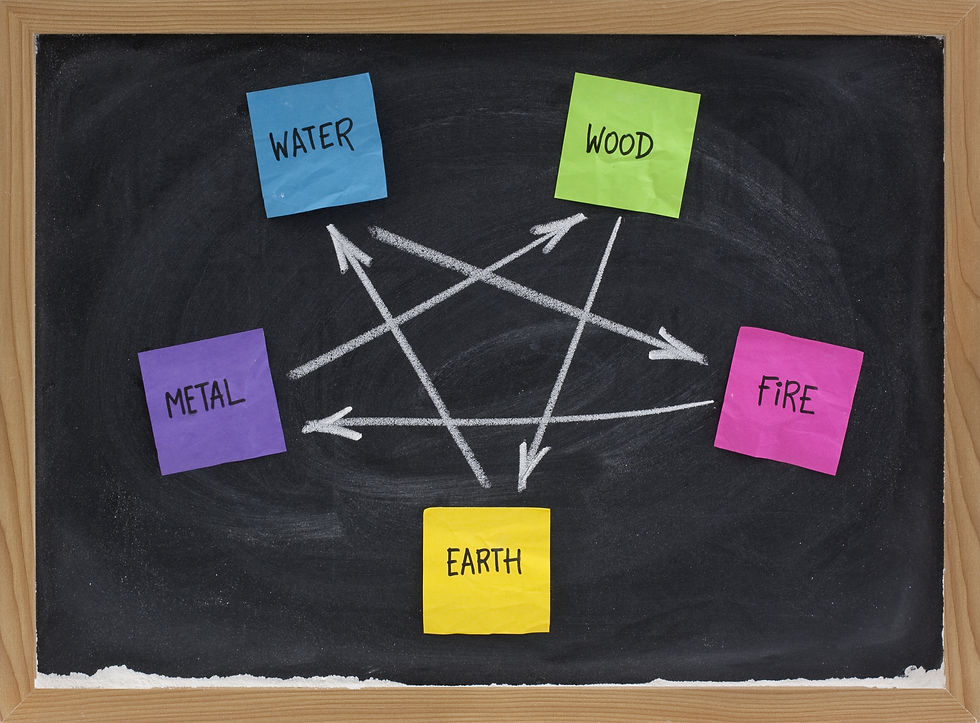
The Five Elements: A Map of Patterns, Not Labels
The Five Elements describe how energy moves through nature and the body across seasons, emotions, and organ systems.
They are not personality types. They are patterns we all cycle through.
🌱 Wood — Spring — Growth & Direction
Associated with the liver & gallbladder
Emotion: anger, frustration
Quality: vision, decisiveness, momentum
When out of balance:
irritability
tension
tight hips, ribs, jaw
difficulty adapting to change
Therapeutic focus:
gentle mobility
coordinated movement
breath that supports flow without force
🔥 Fire — Summer — Connection & Expression
Associated with the heart & small intestine
Emotion: joy (or anxiety when imbalanced)
Quality: warmth, communication, vitality
When out of balance:
agitation
poor sleep
scattered attention
emotional overwhelm
Therapeutic focus:
calming rhythm
breath regulation
practices that soothe the nervous system without shutting it down
🌍 Earth — Late Summer — Stability & Nourishment
Associated with the spleen & stomach
Emotion: worry, rumination
Quality: digestion, grounding, care
When out of balance:
fatigue
heaviness
poor appetite
overthinking
Therapeutic focus:
slow, supportive movement
rest-and-digest practices
simple, repetitive sequences
🪙 Metal — Fall — Letting Go & Clarity
Associated with lungs & large intestine
Emotion: grief, sadness
Quality: boundaries, breath, release
When out of balance:
shallow breathing
stiffness
difficulty releasing emotionally or physically
Therapeutic focus:
breath expansion
gentle opening
practices that support processing and release
💧 Water — Winter — Rest & Reserves
Associated with kidneys & bladder
Emotion: fear
Quality: depth, endurance, recovery
When out of balance:
deep fatigue
low back or knee pain
feeling cold
lack of motivation or drive
Therapeutic focus:
rest
warmth
minimal effort
practices that protect energy rather than spend it
Why This Matters for Yoga & Meditation
Having some training in Traditional Chinese Medicine can help a Yoga Therapeutics teacher decode the individuals they are working with — like a game of connect the dots.
When a teacher can build a therapeutic relationship with an individual, there are opportunities to get to know them, connect dots, build or draw a picture of what’s going on with them and what might be most helpful to them as a whole person.
Applying a framework of TCM can explain why:

aggressive practices can worsen fatigue
“calming” practices can sometimes feel deadening
stillness can be nourishing or overwhelming depending on the moment
movement needs to be dosed, not prescribed universally
Therapeutic yoga asks:
What does this body need today?
Not:
What should I be able to do?
What did I do ten years ago?
What does this class expect?
Meditation, too, is adapted:
some days focus on grounding
some days focus on soothing
some days focus on gentle awareness rather than deep stillness
The Takeaway
You don’t need to memorize Traditional Chinese Medicine theory to benefit from it.What does matter is understanding how this perspective can reshape the way you relate to your body, your symptoms, and your practice.
When principles from TCM are woven into yoga and meditation, they invite a broader, more compassionate way of problem-solving. Instead of viewing discomfort, fatigue, or emotional shifts as isolated issues to fix or push through, you begin to see them as part of a larger, intelligent system responding to life.
This lens offers a few powerful reframes:
Health is influenced by the balance of forces within us, not just by what we do or don’t do.
Symptoms are rarely random or isolated; they reflect patterns unfolding over time.
Health is not a finish line — it’s an ongoing balancing act that shifts with age, stress, seasons, and lived-experiences.
With this understanding, yoga and meditation stop being about achieving a shape, a mood, or a certain outcome — and start becoming tools for listening, responding, and adapting.
What matters most is remembering this:
Your body is not broken.
Symptoms are communication, not failure.
Balance is not an endpoint — it’s an ongoing conversation.
The right yoga and meditation practice supports adaptation, not performance.
This is the heart of a therapeutic approach:meeting your body exactly where it is — honoring its current capacity — and supporting it in moving toward greater ease, clarity, and resilience over time.
Not by pushing harder. Not by doing more. But by working with your body instead of against it.
References
Cruikshank, Tiffany (2023). Women's Health: Yoga Medicine Teacher Training Manual and 500 Hour certification program lecture notes. Williams, Anne (2019). Massage Mastery: From Student to Professional, 2nd Edition. Sweet Orange Education LLC
Williams, Anne (2021). Spa Bodywork: A Guide for massage Therapists, 3rd Edition. Sweet Orange Education LLC.